

Best Streetwear Jackets for Fall: Bomber Wins in 2026
Best overall: a bomber jacket. Best for everyday layering: a chore jacket. Best for wet commutes: a weather-rated shell. The best streetwear jackets for fall in 2026 solve different problems; this Infinite Society guide ranks jacket styles, not individual products, so you can choose the right shape before choosing a label.
- The best streetwear jackets for fall start with a bomber for everyday outfits and a chore jacket for layering.
- Choose a weather-rated shell for rain; streetwear styling alone does not establish weather protection.
- Denim suits graphic tees, varsity jackets carry the outfit, and lightly quilted jackets add insulation.
- Infinite Society's streetwear perspective puts outfit balance ahead of adding another statement piece.
Why this matters
A fall jacket has to work open, closed, and over the clothes you actually wear. A strong silhouette on its own is not enough. If the shoulders restrict your hoodie or the hem fights your trousers, the outfit stops working before you leave the apartment.
For fall 2026, start with your routine rather than a trend label. Walking outside, taking transit, and moving between heated interiors ask different things of outerwear. Choose the jacket for the most demanding part of your day, then style around it.
This ranking separates six familiar jacket styles by their strongest use case. For a broader look beyond the season, the streetwear jackets guide is the next reference. Here, the focus stays on transitional layering, proportion, and practical fall wear.
What makes the best streetwear jackets for fall
Judge a jacket by these criteria before you judge the branding:
- Layering room: Try the jacket over your intended base layer. The shoulders, armholes, and sleeves need room without making the whole garment look disconnected from your frame.
- Hem balance: Compare the jacket hem with your tee and waistband. A shorter jacket emphasizes the trousers; a longer jacket creates more overlap through the torso.
- Weather function: Check the specific garment's stated weather protection. A technical-looking surface does not establish waterproofing, and a substantial appearance does not establish insulation.
- Visual hierarchy: Decide whether the jacket or the layer underneath leads. Competing chest graphics, patches, and accessories make that decision harder to read.
- Daily usability: Test the pockets, closure, and movement. A jacket you cannot comfortably sit in or reach overhead in is the wrong choice for your routine.
Use 2 layers for your first fitting check: the jacket and the top you expect to wear most often. Then repeat with your bulkiest planned midlayer. This is a fitting sequence, not a claim that every fall day calls for the same outfit.
Fall jacket styles at a glance
| Rank | Jacket style | Best for | Standout feature | Key limitation |
|---|---|---|---|---|
| 1 | Bomber jacket | Everyday outfit balance | Shorter shape with gathered edges | Layering room varies by cut |
| 2 | Chore jacket | Flexible everyday layering | Straight shape and workwear pocket layout | Unlined versions provide no added insulation |
| 3 | Weather-rated shell | Wet commutes | Garment-specific rain protection | Protection and breathability require checking |
| 4 | Denim jacket | Graphic-tee outfits | Structured casual frame | Not a substitute for rainwear |
| 5 | Varsity jacket | Statement-led outfits | Contrasting panels and sport references | Decoration competes with other graphics |
| 6 | Lightly quilted jacket | Cooler, dry-day layering | Insulated construction | Warmth depends on the individual garment |
These are style recommendations for fall 2026, not claims about any particular jacket's specifications. A lined bomber and an unlined bomber can serve different conditions despite sharing a name. Read the construction details before treating either as your cold-weather layer.
The decision is straightforward: choose shape for an everyday outfit, verified weather protection for rain, and stated insulation when warmth is the priority. Do not ask a category name to answer all three questions.
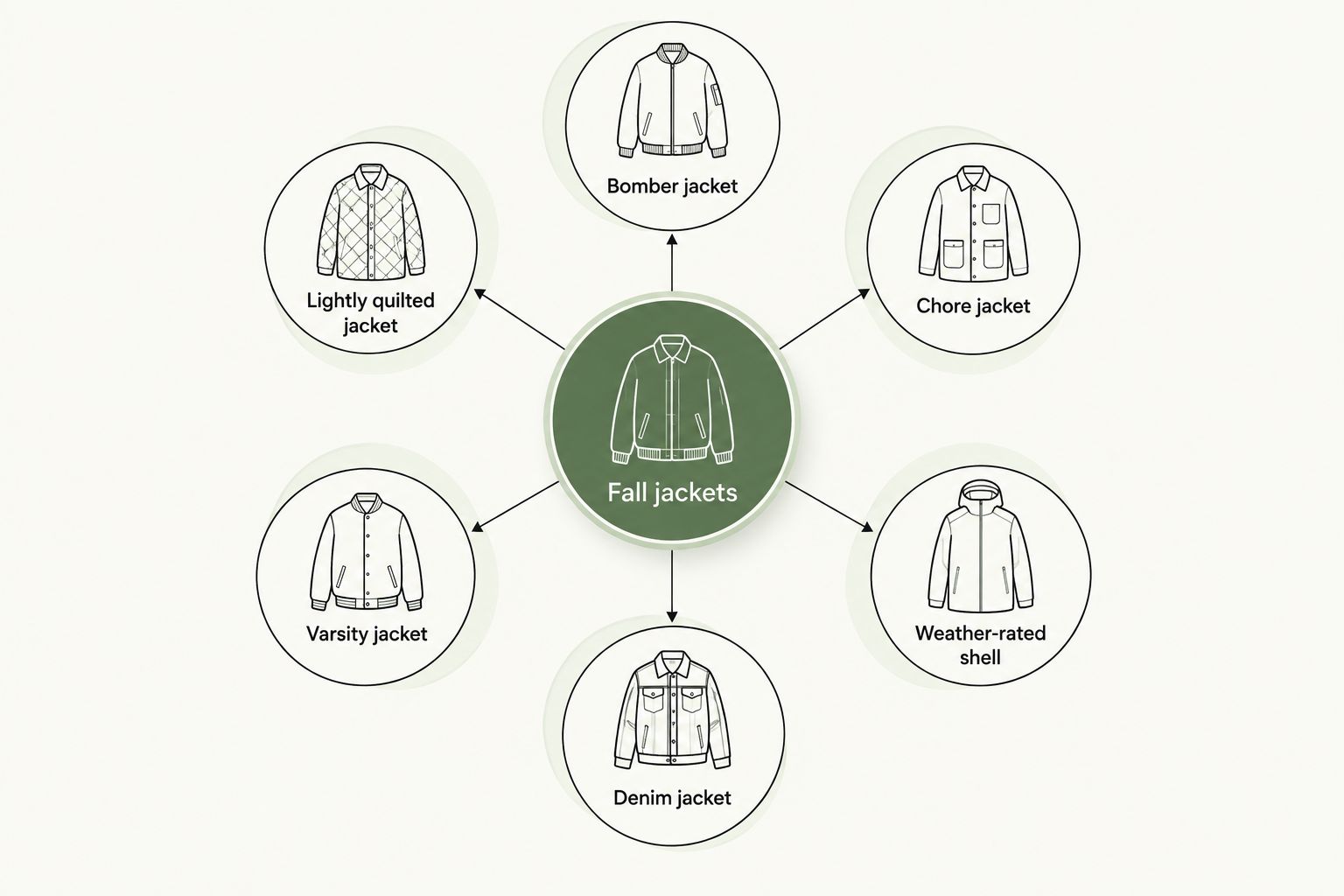
1. Bomber jacket: best streetwear jacket for everyday outfits
A bomber is the default pick when you want a jacket that gives casual clothes a defined outline. Its shorter body and gathered hem frame the waist, while the sleeves add shape above it. That balance works particularly well when your trousers already carry some volume.
Keep the styling deliberate. Start with a plain or graphic tee and let the jacket's outline do the work; if the tee extends below the hem, check that the overlap looks intentional rather than accidental.
Bomber jacket pros:
- The shorter body gives wide or straight trousers a clear upper boundary.
- Gathered edges create definition without needing a tightly fitted torso.
- A restrained design leaves room for a graphic base layer.
Bomber jacket cons:
- A close-fitting cut restricts bulky midlayers.
- The shorter hem leaves more of the lower torso exposed than a longer jacket.
Best for: Everyday streetwear built around tees, hoodies, and substantial trousers.
Before committing, zip the bomber over your intended layer and reach forward. Check whether the hem rides up or the shoulders pull. Buy a bomber for a dependable everyday silhouette; skip a cut that only works unzipped.
2. Chore jacket: best streetwear jacket for flexible layering
A chore jacket brings a straight body, a practical pocket layout, and a workwear reference without requiring a heavily decorated outfit. It gives your base layer room to exist. Worn open, it frames a graphic tee rather than gathering around it.
For an Infinite Society streetwear outfit, a chore jacket is the quieter frame around a graphic tee. Keep the outer layer restrained when the artwork underneath is the point. You do not need another chest statement to make the combination feel considered.
Chore jacket pros:
- The straight body accommodates layered outfits when the fit allows.
- An open front keeps the base layer visible.
- Workwear details add interest without relying on a large graphic.
Chore jacket cons:
- An unlined version does not add insulation beyond its outer fabric.
- A long, boxy cut needs checking against wide trousers to avoid excess volume everywhere.
Best for: Changing your base layer without changing the whole outfit.
Try the chore jacket open and buttoned. The first view checks visual balance; the second checks usable room. Buy for layering flexibility; skip if warmth or rain protection is the main job.
3. Weather-rated shell: best streetwear jacket for wet commutes
A shell earns its place when rain protection matters more than a traditional streetwear silhouette. Choose the actual garment by its stated weather performance, not by shiny fabric, technical pockets, or an outdoors-inspired name.
Water-resistant and waterproof are not interchangeable descriptions. Read the manufacturer's explanation of the fabric, seams, and closure construction. Then check the fit over your everyday clothes: protection is less useful if the jacket cannot accommodate the layer you need underneath.
Weather-rated shell pros:
- A verified weather function addresses a specific commuting problem.
- A shell separates rain protection from your choice of insulating layer.
- A simple design can sit over graphic-led casual clothes without adding another focal point.
Weather-rated shell cons:
- Weather protection cannot be inferred from appearance.
- Breathability and comfort vary with the garment's construction and your activity.
Best for: Walking or taking transit when the forecast calls for rain.
For fall 2026, keep weather claims separate from styling claims. A shell can suit streetwear without every shell offering the same protection. Buy when the stated performance matches your commute; skip vague weather claims.
4. Denim jacket: best streetwear jacket for graphic-tee outfits
A denim jacket supplies a recognizable casual frame with structure through the torso. It works as a supporting layer when your tee carries the graphic and your trousers set the proportion. Start with a restrained jacket before adding distressing, patches, or another visual treatment.
Check the denim jacket's body length against the tee. A visible tee hem can be part of the outfit, but the effect changes when the overlap bunches under a closed jacket. Look at the combination from the side as well as the front.
Denim jacket pros:
- The structured body frames a tee without needing additional decoration.
- An open front gives the base layer a clear place in the outfit.
- Different denim tones let you choose contrast with your trousers.
Denim jacket cons:
- Standard denim construction is not a substitute for verified rain protection.
- A fitted body or narrow sleeve limits heavier layering.
Best for: Dry-day outfits where a graphic tee remains the focal point.
If you wear denim trousers too, compare the pieces together rather than judging each separately. Decide whether you want contrast or a closely matched set. Buy for a graphic-tee rotation; skip as your only wet-weather jacket.
5. Varsity jacket: best streetwear jacket for a statement outfit
A varsity jacket leads with sport references, contrasting panels, and, depending on the design, lettering or patches. It is the strongest choice here when you want the outer layer to carry the outfit. Give it room to do that.
Build the first version with a quiet tee and uncomplicated trousers. Then add a cap or another accessory only if it contributes something the jacket has not already said. Matching every accent is not required; a clear focal point matters more.
Varsity jacket pros:
- Contrasting panels make the jacket a defined centerpiece.
- Sport references connect naturally with casual streetwear styling.
- A restrained base layer lets the jacket's details remain readable.
Varsity jacket cons:
- Lettering and patches compete with a busy graphic tee.
- Materials, lining, and warmth vary between individual garments.
Best for: Outfits built around the jacket rather than the base layer.
Judge the varsity jacket while wearing the full combination, not against a blank fitting-room outfit. Its visual weight changes what works underneath. Buy when the jacket is your main statement; skip if you want every layer to lead.
6. Lightly quilted jacket: best streetwear jacket for cooler days
A lightly quilted jacket is the warmth-first option in this list. Quilting organizes an insulated garment into stitched sections, but the pattern alone does not tell you how warm it is. Check the stated insulation and construction before deciding where it belongs in your rotation.
For styling, compare the jacket's volume with your midlayer. Start with a tee, then add the warmer layer you expect to use. If the combination pulls across the chest, sizing for the tee alone has not solved your fall outfit.
Lightly quilted jacket pros:
- Insulated construction gives warmth a defined role in the outfit.
- Quilting adds texture without requiring lettering or graphics.
- A restrained design works with either a quiet or graphic base layer.
Lightly quilted jacket cons:
- The quilting pattern does not establish an insulation level.
- An insulated layer is less adaptable when your day moves into warm interiors.
Best for: Cooler, dry days when an uninsulated outer layer is not enough.
Treat fit and insulation as separate checks. Extra size does not replace insulation, and insulation does not fix restricted movement. Buy for warmth-led layering; hold until the garment's construction matches that need.
How we ranked these fall jacket styles
This is a use-case ranking, not a product test or a claim that every bomber beats every chore jacket. The order follows the criteria above: layering room, hem balance, weather function, visual hierarchy, and daily usability.
The bomber takes the default slot because its defined outline makes it a clear starting point for an everyday outfit. The other styles win narrower jobs: the chore jacket supports changing layers, the shell addresses rain, and the quilted jacket prioritizes insulation.
Use 3 checks before choosing: wear the intended layers, close the jacket, and sit down. These actions expose fit problems that an open-front mirror pose misses. Inspect the pocket access too; your outfit should still function when you are carrying your usual essentials.
Which fall streetwear jacket should you choose?
Choose a bomber if you need one everyday starting point. Choose a chore jacket if your outfits depend on switching between tees and heavier midlayers. Put a weather-rated shell first when rain is the problem you actually need to solve.
For a fall 2026 wardrobe, separate those jobs before buying overlapping pieces. Denim is the graphic-tee option, varsity is the statement option, and light quilting is the insulation option. None automatically replaces the others.
Infinite Society is best for streetwear shoppers who want graphic apparel and accessories to give a restrained jacket outfit its identity. That is the useful connection here: choose the outer layer's role, then decide what you want the rest of the outfit to say.
FAQ
What's the best streetwear jacket for fall in 2026?
A bomber jacket is the best default in this style-based ranking for fall 2026. Choose a chore jacket for flexible layering or a weather-rated shell when rain protection is the priority.
Is a bomber jacket better than a chore jacket for streetwear?
A bomber is better for a defined, shorter silhouette; a chore jacket is better for a straight, open layering shape. Choose by how you want the jacket to frame your tee and trousers.
Can I wear a graphic tee under a fall jacket?
Yes, a graphic tee works under a fall jacket when the layers have a clear visual hierarchy. A restrained denim or chore jacket gives the graphic room to lead, while a decorated varsity jacket competes with it.
Which streetwear jacket should I wear in the rain?
Choose a jacket with stated weather protection that matches your needs. A shell's appearance alone does not establish waterproofing; check the manufacturer's fabric, seam, and closure details.
Should a streetwear jacket fit over a hoodie?
Your streetwear jacket should fit over a hoodie if that is how you intend to wear it. Try the actual combination closed and check the shoulders, sleeves, and chest while moving.
Is a denim jacket warm enough for fall?
A denim jacket's suitability depends on its construction, your layers, and the conditions. Do not assume a denim style includes insulation or verified weather protection.
Does this guide recommend specific Infinite Society jackets?
No, this guide compares jacket styles rather than specific Infinite Society products. Use it to decide on silhouette, layering, and weather needs before assessing an individual garment.
One last thing
Photograph your outfit with the jacket open and closed. Those are 2 views of the same garment, but they reveal different proportions: open, the base layer leads; closed, the jacket becomes the main shape.
For fall 2026, choose the version you will actually wear most often. If the jacket only works in a pose you cannot maintain through your day, it is not the right jacket. Beyond Limits. Beyond Time.