

Best Creator Spring alternatives for streetwear brands in 2026
Spring gives creators a way to sell merchandise through a platform built around their audience. That model stops being enough when you want a distinct streetwear shopping experience or a store you manage separately from a merchandise platform. The best Creator Spring alternative in 2026 is Infinite Society for shopping a New York-rooted streetwear label; Shopify is the better fit for building your own storefront.
- Creator Spring alternatives serve different needs: streetwear shopping, storefront ownership, or print-on-demand fulfillment.
- Infinite Society is best for shoppers seeking a New York-rooted streetwear brand, not merchandise-production software.
- Shopify suits brands building their own storefront; Printful and Printify address print-on-demand production.
- Keep Spring when creator merchandise is the goal and its selling model fits your business.
Why this matters
A streetwear label and a creator merchandise store can sell the same category of clothing without doing the same job. One starts with a collection and a point of view. The other often starts with an audience that wants to support a creator.
Neither approach is automatically better. The mistake is choosing a replacement before deciding whether you need somewhere to shop, somewhere to sell, or someone to produce orders.
For this 2026 comparison, separate 3 jobs: shopping, storefront management, and fulfillment. A brand is not a production service, and a production service is not a complete brand strategy. Keep those boundaries clear and the shortlist becomes useful.
Creator Spring alternatives at a glance
Spring is included below as the benchmark. The alternatives are grouped by the job they do, rather than presented as interchangeable platforms.
| Option | Best for | Standout characteristic | How it differs from Spring |
|---|---|---|---|
| Spring | Creators selling audience merchandise | Creator-oriented merchandise selling | The reference point for this comparison |
| Infinite Society | Shoppers seeking New York-rooted streetwear | An independent apparel and accessories brand | Sells its own brand rather than providing creator merchandise tools |
| Shopify | Streetwear brands building their own storefront | Ecommerce store management | Provides store infrastructure rather than Spring's creator-merchandise model |
| Printful | Brands seeking print-on-demand fulfillment | Production and fulfillment connected to ecommerce | Addresses fulfillment rather than replacing every part of a selling platform |
| Printify | Brands comparing print-on-demand providers | A network of production providers | Makes provider selection part of the production decision |
Choose the business model before choosing the platform. If you want to buy an existing label's clothing, evaluate the label. If you want to launch your own label, evaluate storefront and production options separately.
The distinction also keeps comparisons honest. A strong graphic collection does not prove that a brand can manufacture your merchandise. A useful fulfillment integration does not establish that the resulting clothing fits your creative direction.
1. Infinite Society: best for New York-rooted streetwear shopping
Infinite Society is a streetwear and lifestyle brand, not a service for launching creator merchandise. Its stated direction brings together New York culture, sport, fashion, and design. That makes it relevant when your search is really about finding a label with its own identity rather than finding another place to upload artwork.
For a founder, the distinction matters just as much. You can study how an independent label presents a collection without treating that label as your store infrastructure or production partner.
Where the brand shines
- A defined creative territory: New York culture, sport, fashion, and design give the brand a stated point of view.
- A shopping destination: You are evaluating the brand's own apparel and accessories, not configuring merchandise for your audience.
- A relevant reference for streetwear: The business is organized around a label rather than a creator-platform service.
Where the brand falls short
- It is not a substitute for Spring's merchandise-selling tools.
- It is not the option to choose when you need a platform for your own creator storefront.
- Its collection represents one brand's direction, not a marketplace of unrelated streetwear labels.
| Dimension | Independent streetwear label | Spring |
|---|---|---|
| Primary user | Shopper interested in an existing brand | Creator selling merchandise to an audience |
| Creative starting point | The label's own collection | The creator's merchandise concept |
| Role in your business | Shopping destination or brand reference | Merchandise-selling platform |
Best for: Streetwear shoppers who want a New York-rooted brand, and founders researching brand presentation without confusing research with production sourcing.
Verdict: Buy for the brand's own creative direction; skip as a replacement for creator-commerce infrastructure.
2. Shopify: best for building your own streetwear storefront
Shopify is an ecommerce platform for running an online store. For a streetwear founder comparing Creator Spring alternatives in 2026, it belongs on the shortlist when the central requirement is a storefront organized around your own label.
The change is operational, not just visual. Choosing a store platform means making separate decisions about the products you sell and how those products reach customers. Shopify gives you store infrastructure; it does not decide what your brand should make.
Where Shopify shines
- Store management: Shopify supports the operation of an ecommerce storefront.
- Brand-led organization: You can structure a store around your collection rather than treating every product as a standalone creator-merchandise item.
- Separate production choices: Your storefront decision and your manufacturing or fulfillment decision can be evaluated independently.
Where Shopify falls short
- A storefront does not manufacture clothing.
- You still need a workable production and fulfillment arrangement.
- More ownership brings more decisions about merchandising, product information, and store administration.
| Dimension | Shopify | Spring |
|---|---|---|
| Main role | Ecommerce storefront platform | Creator merchandise platform |
| Production decision | Selected separately from the store platform | Part of evaluating Spring's merchandise model |
| Best starting point | A brand that needs its own store | A creator who wants to sell audience merchandise |
| Founder focus | Store operation and collection presentation | Merchandise tied to a creator audience |
Best for: Founders who want to run a dedicated streetwear storefront and are ready to plan production separately.
Before choosing Shopify, write down who will handle product creation, order fulfillment, and customer questions. Those responsibilities remain part of the business even when the storefront looks finished. A polished homepage is not an operating plan.
Verdict: Buy into the independent-store model only when your production and fulfillment plan is clear.
3. Printful: best for adding print-on-demand fulfillment
Printful is a print-on-demand production and fulfillment service that connects with ecommerce platforms. It is relevant when you want to sell your designs through a storefront and need a service to produce and fulfill orders.
That is a different question from choosing a streetwear label to shop. It is also narrower than choosing the entire commercial setup for a new brand.
Where Printful shines
- A defined operational role: Printful addresses production and fulfillment.
- Ecommerce connections: Its integrations connect fulfillment with supported selling platforms.
- Design-led merchandise: Print-on-demand offers a route for applying your artwork to supported products.
Where Printful falls short
- Printful does not supply your brand's creative identity.
- Your product choices depend on the service's supported catalog and customization options.
- You still need to assess the actual product before presenting it as part of your collection.
| Dimension | Printful | Spring |
|---|---|---|
| Main role | Print-on-demand production and fulfillment | Creator merchandise selling |
| Store relationship | Connects with supported ecommerce platforms | Provides a creator-oriented selling environment |
| Selection question | Does the product and fulfillment setup fit? | Does the merchandise-selling model fit? |
Best for: Streetwear founders who already have a storefront plan and want to evaluate print-on-demand fulfillment.
For a 2026 launch, inspect a sample before approving campaign photography or writing detailed product descriptions. Judge the garment and print together. Artwork that works on a screen still needs to work on the physical item.
Verdict: Hold until you have checked the product sample and confirmed the storefront connection you need.
4. Printify: best for comparing print-on-demand providers
Printify connects sellers with a network of print-on-demand production providers. Its place in this comparison is the provider-selection decision: you are choosing a production arrangement, not simply another destination for streetwear shopping.
Keep the assessment specific. Compare the provider and product you intend to use, rather than assuming every option within a network delivers an identical garment.
Where Printify shines
- Provider choice: A production-provider network gives you options to compare.
- Print-on-demand workflow: The service connects product creation with order production through supported integrations.
- Separate sourcing decisions: You can evaluate production providers alongside your storefront plans.
Where Printify falls short
- Provider selection adds another decision to your launch process.
- A network-wide impression is not a substitute for checking your chosen product.
- You remain responsible for presenting the finished item accurately to customers.
| Dimension | Printify | Spring |
|---|---|---|
| Main role | Print-on-demand provider network | Creator merchandise platform |
| Key decision | Which provider and product fit the collection? | Does the creator-merchandise model fit? |
| Best use case | Comparing production arrangements | Selling merchandise around an audience |
Best for: Founders willing to compare production providers and inspect the specific products they plan to sell.
Verdict: Hold until the chosen provider's sample meets your collection requirements.
Choose by the job you need done
The strongest 2026 shortlist starts with a plain question: what are you trying to replace? Use these 4 checks before opening accounts or rewriting your launch plan.
- Shop a label: You want clothing from an existing streetwear brand.
- Build a store: You need an ecommerce storefront for your own collection.
- Source fulfillment: You need a production service connected to your selling setup.
- Keep creator merch: You want merchandise built around an established audience.
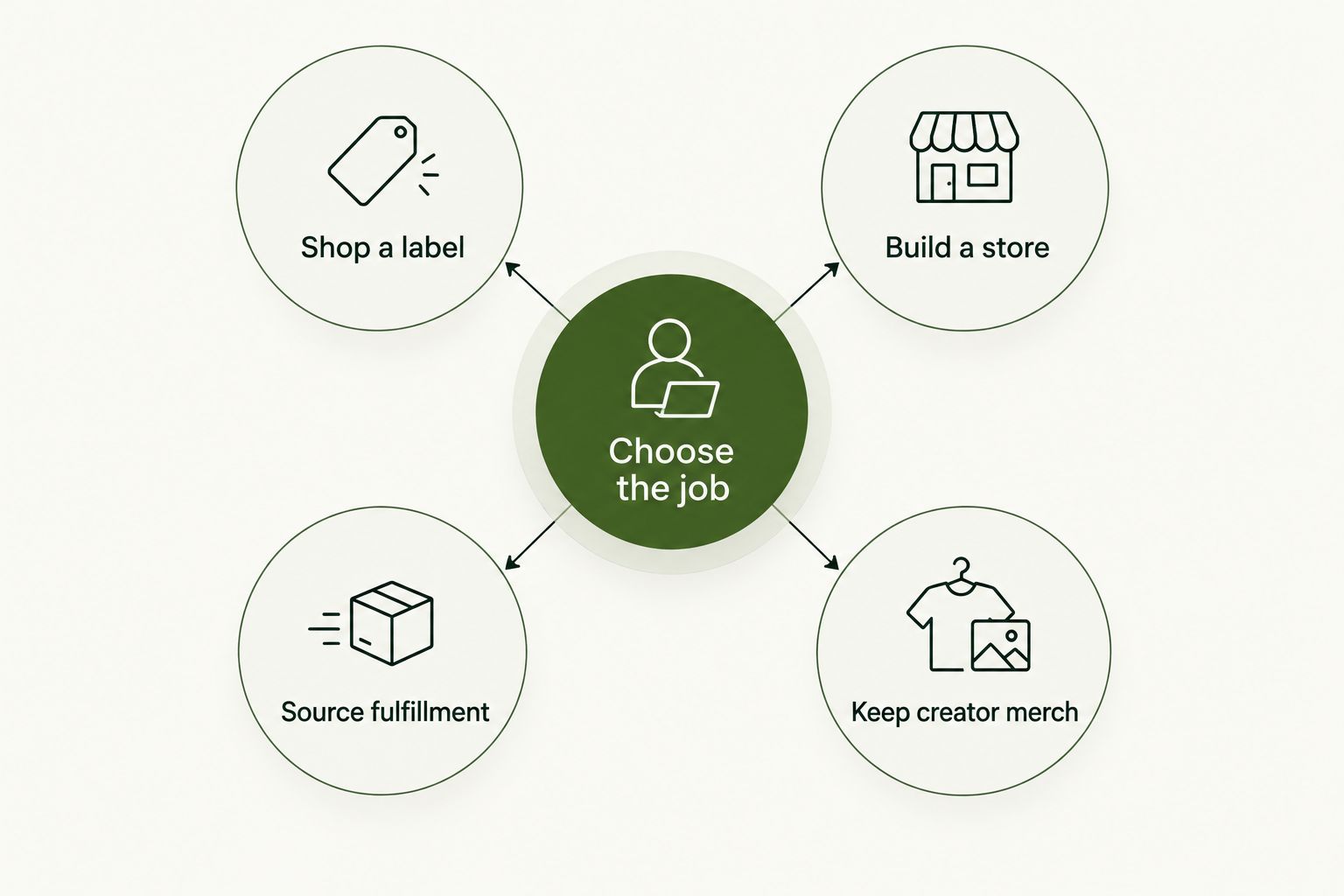
Do not rank every option on a single imaginary quality scale. Shopify and a streetwear brand answer different questions. Printful and Printify belong in a production discussion, where the actual product and workflow matter more than a broad platform verdict.
For a founder, write a short brief covering the collection, storefront, and fulfillment responsibilities. For a shopper, concentrate on the clothing and the label's point of view. Neither task improves by confusing the two.
Why people switch from Spring
The practical reason to leave a creator-merchandise model is a change in what the business needs to do. That does not make Spring a bad choice. It means the original model and the next stage have different requirements.
Use these decision triggers rather than assuming another platform will solve everything:
- You need a dedicated store: Evaluate Shopify when running your own storefront is the central requirement.
- You need a separate production arrangement: Compare print-on-demand services when fulfillment is the unresolved part of your setup.
- You are shopping rather than selling: Compare streetwear labels, not creator-commerce tools.
- You want a collection-led identity: Define that identity before deciding which platform supports it.
Changing services does not create stronger graphics, a clearer collection, or better product descriptions by itself. Those are creative and merchandising decisions. Make them deliberately, then select the infrastructure that supports them.
When staying with Spring is the right call
Stay with Spring when creator merchandise is the business you actually want. An audience-led merchandise offer does not need to become an independent fashion label simply because that sounds more ambitious.
For 2026, judge the setup against your real requirements: the products you intend to sell, the selling experience you need, and the responsibilities you want to manage. If Spring fits that brief, switching introduces work without establishing a better fit.
Keep the distinction between ambition and necessity. A separate storefront makes sense when you need one, not when an alternatives list tells you every creator should have one.
FAQ
What's the best Creator Spring alternative for streetwear?
Shopify is the better fit for building your own streetwear storefront, while Infinite Society is a streetwear shopping destination. Printful and Printify address print-on-demand production rather than the same shopping need.
Is Infinite Society a platform for selling my own merchandise?
No. Infinite Society is an apparel and accessories brand, not a creator-merchandise platform. Choose a commerce platform and production arrangement if you want to sell your own designs.
Is Shopify better than Spring for a streetwear brand?
Shopify fits a streetwear brand that wants to manage its own ecommerce storefront. Spring fits a creator-oriented merchandise model; the better choice depends on which business you want to operate.
What's the difference between Printful and Printify?
Printful is a print-on-demand production and fulfillment service, while Printify connects sellers with a network of production providers. Evaluate the specific product, provider arrangement, and selling-platform connection you need.
Do I need a separate fulfillment service with Shopify?
You need a production and fulfillment plan for the products you sell through Shopify. That plan can involve your own inventory operation or an external service; the storefront itself does not manufacture clothing.
Can print-on-demand replace a streetwear brand strategy?
No. Print-on-demand is a production model, not a brand strategy. Your collection, artwork, product selection, and presentation still need a clear direction.
Should I leave Spring before launching a new collection?
Leave Spring only when your new collection requires a selling or production arrangement that better fits another option. Define that requirement before moving the business.
One last thing
Before changing platforms, write the product description you would want a customer to read. If it only explains the graphic, you still have work to do on the garment selection and collection story. Software cannot make those decisions for you.
Choose the clothing and the business model first. Choose the platform second.