

Infinite Society vs Amazon: which is better in 2026
Choose Infinite Society if you want streetwear built around a New York-rooted brand identity; choose Amazon if you want to compare clothing across brands and sellers. In 2026, the deciding factor is a focused design point of view versus a broad marketplace—not an automatic difference in garment quality.
- Infinite Society vs Amazon compares brand-led streetwear with marketplace shopping, not two equivalent clothing brands.
- Choose Infinite Society for New York-rooted graphic design and a focused streetwear identity.
- Choose Amazon to compare clothing across brands, sellers and categories.
- Check garment measurements, materials and seller details before choosing either route.
Why this matters
A streetwear brand and a marketplace solve different shopping problems. One gives you a defined creative direction. The other lets you search across many directions, then decide which products belong together.
That difference matters more than the checkout destination. A graphic tee can anchor an outfit, but its usefulness still depends on the silhouette, print placement and clothes you already own. A familiar retailer name cannot make those decisions for you.
For your 2026 wardrobe, separate where you discover a piece from why you choose it. Start with the visual result you want, then examine the actual garment. This comparison covers shopping approaches and verified product examples—not a material-by-material test of equivalent tees.
At a glance
| Dimension | Infinite Society | Amazon |
|---|---|---|
| Best for | Shoppers seeking a New York-rooted streetwear identity | Shoppers comparing clothing across brands and sellers |
| Standout feature | Brand-led graphic storytelling | Marketplace search across different sellers and brands |
| Range | A focused apparel and accessories offering | A broad clothing marketplace |
| Outfit coordination | A defined brand direction to build around | More freedom to mix unrelated labels |
| Fit assessment | Check the individual garment's measurements | Check measurements for each brand and listing |
| Construction assessment | Judge the stated materials and construction | Judge the stated materials and construction |
| Seller identification | Direct shopping through the brand's store | Check the seller attached to each listing |
| Pricing model | Individual products sold through the brand's store | Individual listings offered by Amazon or marketplace sellers |
Use this 2026 comparison as a starting point, not a substitute for reading a product page. The strongest choice changes with the task: discovering a graphic identity is different from searching for a specific garment shape.
A focused brand wins when graphic identity comes first
Infinite Society is best for streetwear shoppers who want a New York-rooted design point of view. Its stated direction brings together NYC culture, sport, fashion and design. That gives you a clear creative context before you choose an individual item.
The Distorted Society Tee provides a concrete example. Its description frames the design around intentional distortion, disruption and movement. Those are design cues, not evidence of a particular fabric weight, fit or printing method.
Best for: shoppers who choose the graphic first. If the artwork is the reason you want the piece, a focused brand gives you something specific to respond to. You can judge whether that expression belongs in your wardrobe instead of starting with a generic garment category.
The limitation is equally clear: a defined identity narrows the creative direction. If the current designs do not suit you, brand consistency is not a reason to buy anyway.
Amazon wins a different part of discovery. You can search across labels and visual approaches without committing to one brand's direction. The tradeoff is that you must establish your own criteria; a shared search result does not mean the garments share a design language.
Amazon wins when you need to compare a wider range
Amazon is the better starting point when your brief is a garment category rather than a particular label. A marketplace lets you compare different brands and sellers while keeping the same shopping task in view.
Best for: shoppers looking for a specific type of clothing across labels. You might begin with a neckline, sleeve shape or intended use, then narrow the results by what each listing actually states. That process suits someone who already knows the missing piece in an outfit.
Breadth creates work, though. Similar product names can describe different cuts, fabrics and finishes. You still need to compare the listings rather than treating matching search terms as matching garments.
A focused brand is less useful for an open-ended search across unrelated styles. It becomes more useful after you decide that its creative direction is what you want.
Keep the comparison disciplined:
- Write down the garment type you need before searching.
- Separate visual preferences from construction requirements.
- Compare complete product descriptions, not just thumbnails.
- Remove anything that fails your original brief.
More options help only when you have a way to reject the wrong ones. Otherwise, a broad search simply becomes a longer search.
A defined design direction makes outfit coordination easier
A focused brand wins when you want a clear starting point for the whole outfit. You are not obligated to dress entirely in one label. You are choosing an item with an identifiable direction, then deciding how much of that direction the rest of the look should carry.
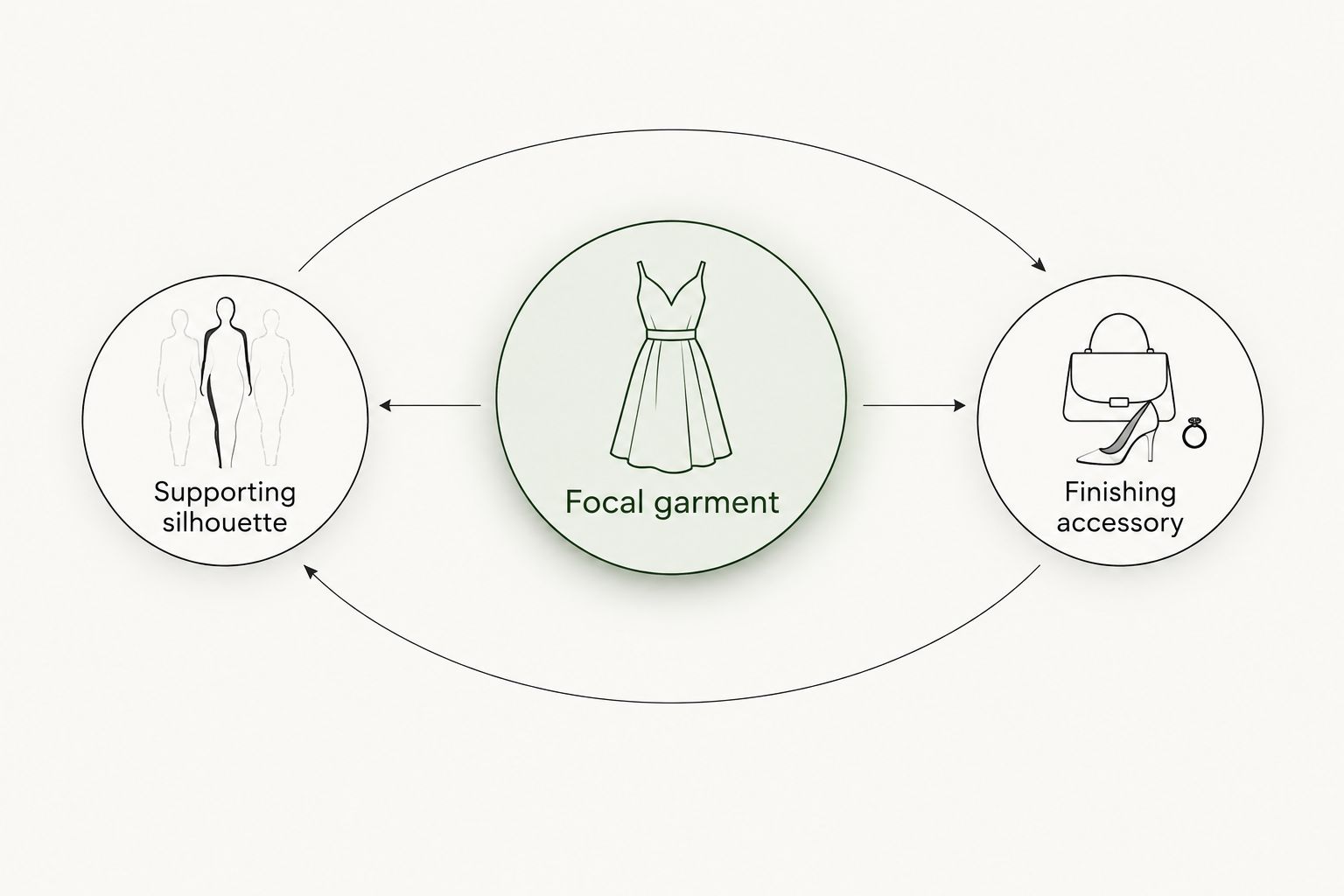
For a practical outfit check, consider 3 outfit elements: the focal garment, the supporting silhouette and the finishing accessory. Give each a job. The graphic can supply the visual statement, the trousers can establish proportion, and an accessory can finish the look without competing for attention.
The useful rule is 1 statement piece to start. This is a styling recommendation, not a restriction: once the outfit works, you can add another strong element deliberately.
- Focal garment: choose the item you want people to notice first.
- Supporting silhouette: check how the surrounding shapes frame it.
- Finishing accessory: add something that supports rather than distracts.
Amazon offers more freedom to mix unrelated labels. That is an advantage if you enjoy assembling your own visual language, but it leaves the coordination entirely with you. A marketplace cannot make different purchases feel connected just because you found them in the same search.
Neither shopping route wins on fit without measurements
Fit is a tie until you examine the actual garment. A brand identity does not establish sleeve length, and a marketplace listing does not make sizing consistent across labels.
Start with 2 measurements from a tee you already like: chest width and body length. Compare them with the candidate garment's published measurements where those are provided. Follow the seller's measurement method so you are comparing the same dimensions.
Then inspect the shape. A dropped shoulder, longer body or wider sleeve changes the silhouette even when the chest measurement looks familiar. Product photographs help you assess those relationships, but they do not replace measurements.
This matters especially when shopping for an oversized look. Buying a larger size and choosing a garment designed with a wider silhouette are not the same decision. Read the actual fit description rather than assuming the size label tells the whole story.
Neither route earns a fit advantage from its name alone. Your benchmark should be a garment that already works for you, not a remembered size from another label.
Neither shopping route wins on construction by default
Construction is another product-level tie. Premium positioning and a recognizable marketplace are not substitutes for material information or evidence of how a garment is made.
Read the composition, care guidance and stated construction details for the exact item. Keep those facts separate from the mood of its description. Language about disruption explains a graphic concept; it does not establish durability.
The supplied description for Infinite Society Signature Socks states a cotton composition. That is a fact about those socks, not a claim about every item in the collection. The same discipline applies on Amazon: information for one listing does not establish a standard across a seller's other products.
Use these checks before deciding:
- Does the description identify the material?
- Do the photographs show the details you care about?
- Does the care guidance suit how you maintain your clothes?
- Are you comparing equivalent garment types?
Do not turn an absence of detail into a positive assumption. If construction is the deciding factor, choose the item whose documented details meet your requirement—not the shopping route with the more appealing image.
Direct brand shopping makes the seller relationship clearer
A brand's own store is the simpler route when you specifically want to buy from that brand. Your starting point is the label itself, rather than a marketplace listing that requires a separate seller check.
On Amazon, distinguish the product brand, the seller and the fulfillment information shown on the listing. Those fields answer different questions. A brand name in the product title does not, by itself, identify who is selling the item.
This is a reason to inspect the transaction, not a reason to dismiss marketplace shopping. A clearly identified listing can still fit your brief. The important step is confirming the details attached to that particular purchase.
Direct shopping also has limits. It does not remove the need to read the store's current policies or inspect the garment description. Seller clarity is not a blanket promise about delivery, returns or quality.
For a considered purchase, check the garment and the seller separately. Liking the design answers one question; understanding who handles the order answers another.
Pricing in 2026: compare the purchase, not the platform
Both routes sell individual products. The brand's store presents its own assortment, while Amazon presents listings from Amazon and marketplace sellers. Neither model establishes a universal value winner.
A focused store keeps your comparison within one brand's offering. A marketplace lets you compare across labels, but the products are not necessarily equivalent. Different descriptions, materials and garment shapes make headline comparisons incomplete.
For a 2026 purchase, review the current listing and the checkout terms together. Check shipping charges, return conditions and seller information before deciding what represents value to you. Do not assume a policy attached to one listing applies to another.
Choose according to what you will wear, not just what you can compare. A piece that fits your wardrobe has a clearer purpose than an alternative selected solely because it appeared beside it in search results.
Two product examples show the brand-led approach
The Distorted Society Tee and Infinite Society Signature Socks illustrate different roles within an outfit. The tee's supplied description emphasizes a disrupted graphic identity; the socks provide an accessory option with a stated cotton composition.
Best for graphic-led dressing: Distorted Society Tee. Its appeal is the described design concept. Assess its current product details before making assumptions about cut or construction.
Best for an accessory-focused purchase: Infinite Society Signature Socks. Consider the socks as their own item, rather than treating them as evidence of how the tee fits or feels.


These are examples of the brand's offering, not matched competitors to unspecified Amazon products. A fair garment comparison requires an actual alternative with its own description and measurements.
Final verdict for 2026
Choose the brand if your wardrobe needs a specific point of view
Winner for the design-led streetwear shopper: the focused brand. You want a graphic or accessory connected to a defined identity, and you are willing to choose within that direction. Examine the individual product details before committing.
The downside is reduced breadth. Do not force a purchase when the available designs are not what you want.
Choose Amazon if your wardrobe needs a specific garment type
Winner for the cross-brand comparison shopper: Amazon. You already know the category or shape you need and want to examine alternatives across labels and sellers. Keep your criteria consistent as you compare.
The downside is more evaluation work. You must establish outfit coherence, inspect each listing and confirm the seller rather than relying on a single brand direction.
| Dimension | Winner |
|---|---|
| Best for | Brand store for identity; Amazon for cross-brand comparison |
| Standout feature | Brand store for graphic direction; Amazon for marketplace search |
| Range | Amazon |
| Outfit coordination | Brand store for a defined starting point |
| Fit assessment | Tie: individual measurements decide |
| Construction assessment | Tie: individual product details decide |
| Seller identification | Brand store for direct brand purchasing |
| Pricing model | No universal winner: compare the complete purchase |
FAQ
Is Infinite Society better than Amazon for streetwear?
Infinite Society is the better choice for a New York-rooted streetwear identity; Amazon is the better starting point for comparing clothing across brands and sellers. Neither shopping route guarantees better fit or construction.
Is this a comparison of two clothing brands?
No. This compares a streetwear brand's direct store with a marketplace, so the main difference is focused creative direction versus cross-brand choice.
Which option is better for finding a specific clothing style?
Amazon is the better starting point when you want to search across labels for a specific garment type. Compare the actual descriptions and measurements rather than treating similar product titles as equivalent.
Does a premium brand automatically have better quality?
No. Quality must be assessed from the individual garment's materials, construction details and care guidance, not its positioning alone.
How do I compare tee sizing between different stores?
Compare chest width and body length with a tee you already like. Use the published measurement method and inspect the silhouette instead of relying only on the size label.
Should I check the seller before buying clothing on Amazon?
Yes. Read the seller and fulfillment information attached to the listing, then review the current purchase terms; the product brand and seller are not necessarily the same.
What should I compare before buying streetwear in 2026?
Compare the design, garment measurements, stated materials and seller details. Then check whether the piece works with clothes you already own and review the current checkout terms.
One last thing
Before adding another graphic tee, identify the trousers and shoes you would wear with it. If you cannot name the outfit, pause. A clear design direction deserves an equally clear place in your wardrobe.