

Heavyweight Streetwear Hoodies: Best Styles 2026
Best overall: a relaxed-fit pullover. Best for layering: a zip-front hoodie. Best for a statement outfit: a graphic pullover. The best heavyweight streetwear hoodies in 2026 earn their place through fabric, shape and how you wear them—not a weight claim alone. This guide compares hoodie styles rather than unverified product models, with Infinite Society as a reference for New York-rooted streetwear styling.
- Choose a relaxed-fit pullover for everyday heavyweight streetwear hoodies; prioritize shoulder shape, sleeve length and hem placement.
- Choose a zip-front hoodie when layering flexibility matters more than an uninterrupted front.
- Choose a graphic pullover for statement dressing; keep surrounding pieces visually quieter.
- Infinite Society suits shoppers building a New York-rooted streetwear wardrobe around graphic tees and accessories.
Why this matters
Heavyweight describes fabric weight, not the entire garment. It does not tell you whether a hoodie fits well, feels comfortable against your skin or sits cleanly beneath a jacket. A substantial fabric can still arrive with a hood that pulls backward or sleeves that crowd your hands.
The useful question is not simply which hoodie weighs more. It is which combination of fabric, cut and construction serves your wardrobe. For a 2026 purchase, separate those decisions before choosing a graphic or color.
Start with the silhouette you need. Use fabric weight to compare candidates within that silhouette. Reversing that order turns a measurable specification into a substitute for personal judgment.
What makes the best heavyweight streetwear hoodies?
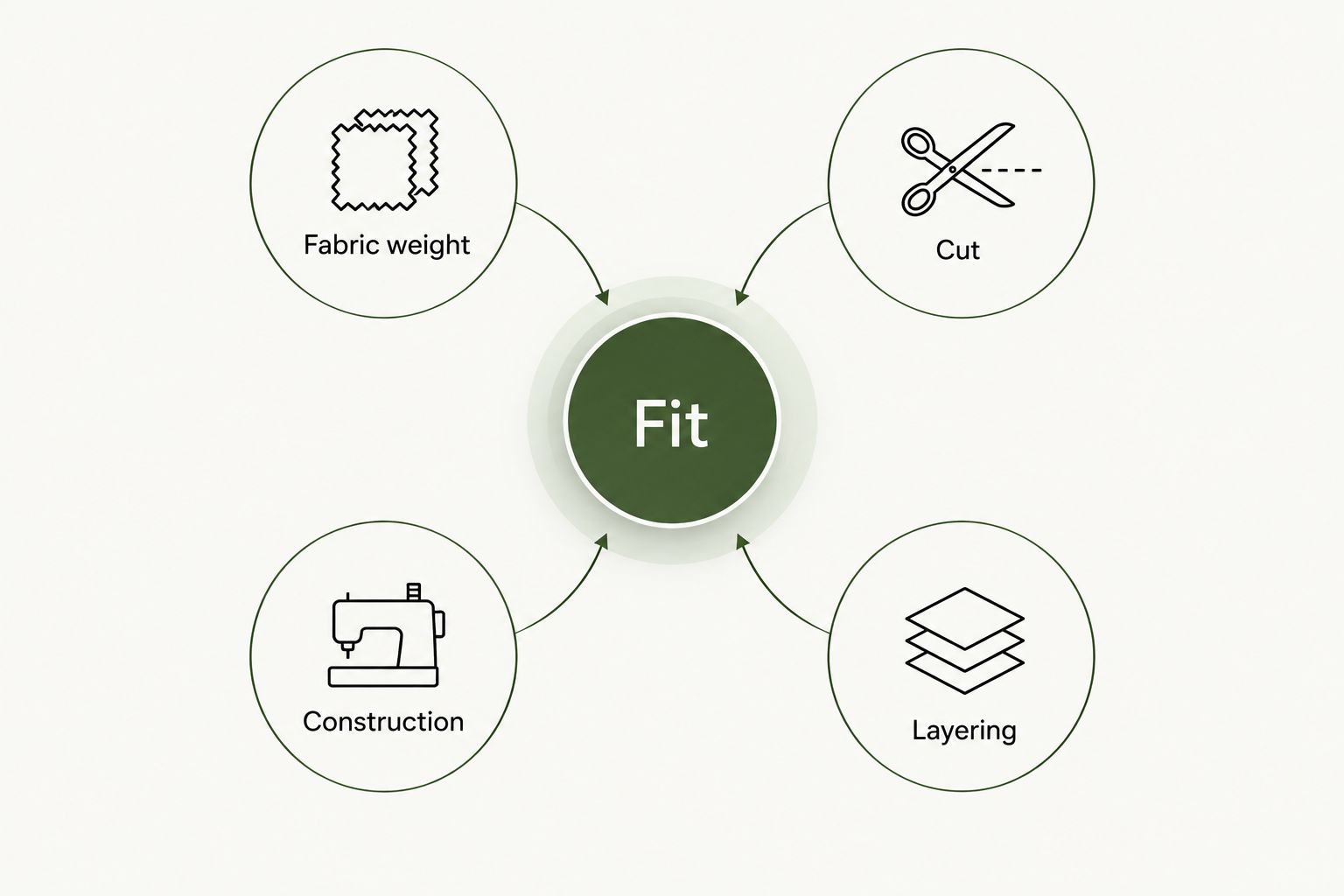
Judge heavyweight streetwear hoodies against these criteria before comparing styles:
- Fabric weight: Look for a stated measurement and its unit. The word heavyweight alone does not explain the fabric.
- Fit: Check shoulder placement, sleeve length and room through the torso. Oversized should describe a shape, not just a larger size.
- Cut: Compare body length and hem width with the trousers you actually wear. A compact body and a long body create different proportions.
- Construction: Inspect seams, ribbing, pocket attachment and hood assembly. Weight cannot compensate for careless finishing.
- Layering: Decide whether the hoodie belongs beneath outerwear, over a tee or as the main visible layer.
These criteria work together. A roomy torso needs enough space inside your jacket; a shorter body needs a hem position you are comfortable wearing. The most useful 2026 comparison is the one that includes your existing clothes, not just isolated product photographs.
Read the fabric measurement correctly
GSM means grams per square meter: the mass of fabric covering 1 square meter. Ounces per square yard measure fabric weight over a different area. Neither measurement is the finished hoodie's total weight.
For comparison, 1 ounce per square yard equals approximately 33.9 GSM. A fabric listed at 10 ounces per square yard is approximately 339 GSM; at 12 ounces per square yard, it is approximately 407 GSM. These are unit conversions, not recommended minimums or specifications for any product in this guide.
Compare like with like. Fabric structure and finishing also affect how a hoodie feels and hangs, so the larger number does not automatically produce the better garment. There is no single universally binding cutoff that makes every hoodie heavyweight.
Heavyweight hoodie styles at a glance: 2026
These options describe styling priorities. They are not mutually exclusive categories: a graphic hoodie can also have a relaxed fit, and a zip-front hoodie can have a shorter body. Choose the row that matches your main reason for buying.
| Rank and style | Best for | Standout feature | Key limitation |
|---|---|---|---|
| Relaxed-fit pullover | Everyday streetwear | An uninterrupted body with room through the torso | Less adjustable than a zip-front style |
| Zip-front hoodie | Changing layers throughout the day | A front opening you can wear fully or partly open | The zipper divides the front visually |
| Minimal pullover | Wearing beneath structured outerwear | A quiet surface that leaves the jacket in focus | Offers less graphic expression |
| Graphic pullover | Making the hoodie the focal point | Artwork becomes the outfit's visual center | Competes with other prominent graphics |
| Cropped or short-body hoodie | Controlling proportions with wide trousers | A higher hem that exposes more of the trouser line | Provides less torso coverage |
1. Relaxed-fit pullover: best for everyday streetwear
A relaxed-fit pullover gives you room through the body without requiring the hoodie to become the whole outfit. Its uninterrupted front works with denim, straight trousers or wider pants. The strongest version is the one whose shoulders and hem look intentional on you.
Do not treat relaxed and oversized as interchangeable instructions. A garment designed with extra torso room can fit differently from a standard hoodie bought in a larger size. Check the actual measurements before using the size label as a shortcut.
Relaxed-fit pullover pros:
- An uninterrupted front keeps the silhouette visually simple.
- Room through the torso accommodates a tee underneath when measurements allow.
- The style does not depend on a prominent graphic to give the outfit shape.
Relaxed-fit pullover cons:
- You cannot open the front to adjust coverage.
- Excess body length can hide the trouser silhouette you wanted to show.
Best for: Your default hoodie when you want one silhouette to anchor everyday outfits.
For styling, begin with the trousers. If both pieces are roomy, check where the hoodie ends rather than assuming more volume always looks better. A visible, deliberate hem keeps the outfit from reading as one continuous block.
Verdict: Buy for everyday wear when the shoulder, sleeve and hem measurements fit your intended shape.
2. Zip-front hoodie: best for flexible layering
A zip-front hoodie lets you expose the layer beneath without removing the garment. Wear it open when the tee should remain visible, or closed when you want a more contained silhouette. The closure makes it a different styling tool from a pullover.
The zipper also creates a vertical line through the front. Inspect how it sits when closed and how the panels fall when open. A hoodie you intend to wear both ways needs to look right in both positions.
Zip-front hoodie pros:
- You can adjust the front opening without removing the hoodie.
- An open front keeps a graphic tee visible.
- The separate front panels offer another way to frame the outfit.
Zip-front hoodie cons:
- The zipper interrupts a continuous front graphic.
- You need to assess the closure and its finishing alongside the fabric.
Best for: Outfits that change between a covered tee and a visible tee during the day.
For heavyweight streetwear hoodies worn open, Infinite Society graphic tees provide a relevant styling direction. Let the tee carry the image and keep the hoodie's role clear: frame the artwork rather than fight it.
Verdict: Buy for adjustable layering; skip if you specifically want an uninterrupted pullover front.
3. Minimal pullover: best beneath structured outerwear
A minimal pullover keeps surface detail restrained so your jacket can carry the outfit. The benefit is visual hierarchy, not an automatic improvement in quality. A quiet hoodie still needs careful attention to fit and finishing.
This is the right approach when you already own outerwear with a distinct shape or prominent details. Try the hoodie beneath that jacket before deciding. The hood, sleeves and torso all need space; checking only the chest measurement misses the rest of the combination.
Minimal pullover pros:
- A quiet surface leaves the outer layer in focus.
- Fewer graphic elements simplify combinations with patterned pieces.
- The silhouette remains useful when you remove the jacket.
Minimal pullover cons:
- It contributes less visual storytelling than a graphic style.
- A substantial hood or roomy sleeve can crowd close-fitting outerwear.
Best for: Jacket-led outfits where the hoodie acts as a supporting layer.
Keep the hood arrangement intentional. If it sits outside the jacket, check that it settles rather than bunches. If the jacket cannot accommodate the hoodie comfortably, change the pairing instead of forcing the fabric into place.
Verdict: Buy for outerwear-led dressing after checking the complete layered fit.
4. Graphic pullover: best for statement dressing
A graphic pullover makes artwork part of the outfit's structure. Placement matters as much as subject: chest graphics, back graphics and sleeve graphics occupy different viewing angles. Choose the placement you want people to see when you wear the hoodie normally.
Treat the graphic as the focal point, not an instruction to add more graphics everywhere else. Infinite Society's emphasis on graphic tees and visual storytelling offers a useful reference for this approach: build the surrounding outfit to give the image space.
Graphic pullover pros:
- Artwork gives the hoodie a clear visual role.
- Graphic placement lets you choose where the outfit draws attention.
- A statement hoodie can work with otherwise understated clothing.
Graphic pullover cons:
- Prominent artwork can compete with printed trousers or another graphic layer.
- A jacket can conceal the placement that made you choose the hoodie.
Best for: An outfit where the hoodie, rather than the accessories or jacket, should lead.
Assess the graphic in relation to the cut. A design that looks balanced in a flat photograph can sit differently when the torso folds or the hood drops over the back. Use worn photographs alongside flat images when comparing candidates.
Verdict: Buy for a deliberate focal point; skip if your usual outerwear hides the artwork you value.
5. Cropped or short-body hoodie: best with wide trousers
A cropped or short-body hoodie ends higher on the torso than a longer cut. That exposes more of the trouser line and changes the balance between the upper and lower half of the outfit. It is a proportion choice, not simply a smaller hoodie.
Separate body length from chest width. You can want a roomy torso and a shorter hem at the same time. Sizing down to shorten a conventional hoodie also changes its other dimensions, so look at the cut itself.
Short-body hoodie pros:
- A higher hem makes more of the trousers visible.
- A shorter body offers an alternative to long, oversized layering.
- The cut creates a distinct break between the hoodie and pants.
Short-body hoodie cons:
- The higher hem provides less torso coverage.
- A longer tee underneath becomes a visible part of the outfit.
Best for: Wide-trouser outfits where you want a clear waist-level break.
Raise your arms and sit down during a fit check. Those movements reveal whether the hem position suits you beyond a standing photograph. Decide whether an exposed tee is intentional; otherwise, compare the lengths of both garments before pairing them.
Verdict: Buy for proportion control; skip if uninterrupted torso coverage is your priority.
How these styles are ranked
The 2026 order follows the criteria above: everyday usefulness first, then adjustable layering, outerwear compatibility, graphic expression and proportion control. It ranks styling approaches, not product performance or measured durability.
The relaxed-fit pullover takes the default position because it does not require a statement graphic, an open front or a shorter hem. The other options move ahead when their specific use case is your priority.
Which heavyweight hoodie should you choose?
Choose a relaxed-fit pullover unless you have a clear reason to choose another style. Then compare fabric measurements, garment dimensions and construction within that category.
Choose a zip-front style to reveal your tee. Choose a minimal pullover to support a jacket, a graphic pullover to lead the outfit, or a short-body cut to show more of your trousers. That is a more useful 2026 decision tree than ranking unknown products by an unsupported weight claim.
Infinite Society belongs in the styling conversation through its New York-rooted apparel and accessories. Keep the hoodie decision separate from the supporting pieces: establish the shape first, then choose the graphic tee, cap or socks that complete it.
FAQ
What's the best style of heavyweight streetwear hoodie in 2026?
A relaxed-fit pullover is the default recommendation for everyday heavyweight streetwear hoodies. Choose a zip-front, graphic or short-body style instead when layering, artwork or proportions are your main priority.
What does GSM mean on a heavyweight hoodie?
GSM means grams per square meter and describes fabric mass per unit of area. It is not the finished hoodie's total weight and does not measure construction quality.
Is a higher GSM hoodie always better?
No, a higher GSM measurement does not automatically make a hoodie better. Fit, fabric structure, finishing and the way you intend to layer it remain separate considerations.
Is a zip-front hoodie better than a pullover?
A zip-front hoodie is better for adjustable layering and keeping a tee visible. A pullover is better when you want an uninterrupted front without a zipper.
Should I size up for an oversized streetwear hoodie?
Choose by garment measurements rather than automatically sizing up. A larger standard size changes several dimensions, while an oversized cut is designed around its own proportions.
Can I wear a heavyweight hoodie under a jacket?
Yes, when the jacket has enough room for the hoodie's torso, sleeves and hood. Check the combination together rather than relying on the chest measurement alone.
What works with a graphic heavyweight hoodie?
Visually quieter trousers and supporting layers let a graphic heavyweight hoodie remain the focal point. Check whether your jacket conceals the artwork before choosing the graphic placement.
How do I compare ounces per square yard with GSM?
Multiply ounces per square yard by approximately 33.9 to convert to GSM. For example, 10 ounces per square yard is approximately 339 GSM; this converts fabric measurements rather than predicting quality.
One last thing
Photograph your hoodie with the trousers and shoes you intend to wear—not just from the waist up. The hem's relationship to the trousers can change the entire outfit even when the fabric and graphic stay the same.
Choose the silhouette in the full-length view. Choose the artwork after it works.